
Kelly Clarkson, a mechanical bird and knowing when to put your phone down
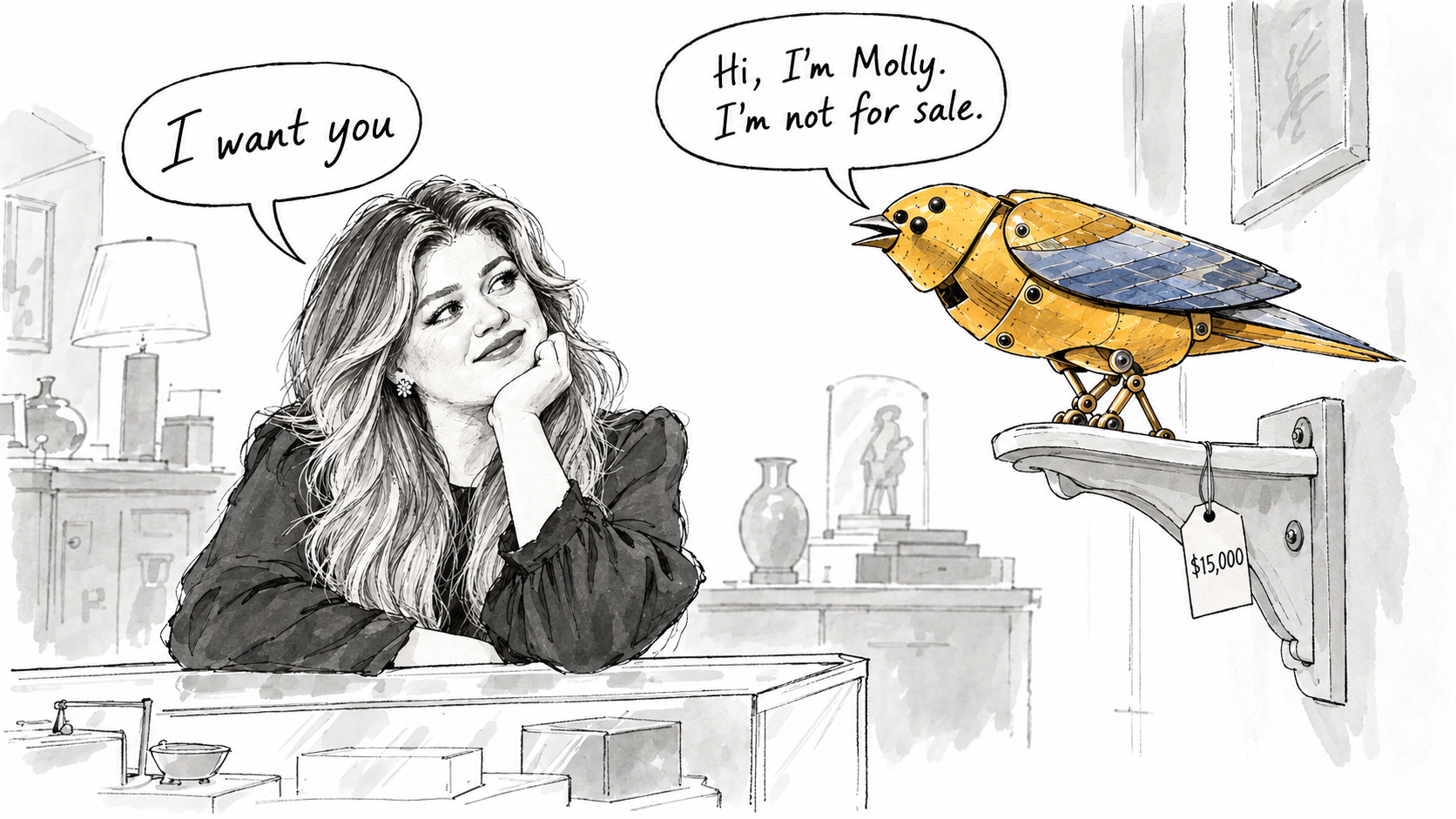
There is something oddly revealing about a public argument over a $15,000 mechanical bird. The object itself is so unnecessary, so wonderfully specific, that it should make the whole thing difficult to take seriously. Yet here we are, examining competing accounts of a shopping trip to establish whether a famous woman was insulted while attempting to purchase a bird called Molly.
I hadn’t expected Molly to become a useful case study in crisis communications, but she has apparently had a busy week.
Kelly Clarkson publicly criticised Brooklyn curiosity shop Art of Play after saying an employee treated her as though she could not afford what she wanted to buy. She compared the experience to Pretty Woman. The shop disputed her account, Clarkson challenged its explanation, and further statements followed. What began as an allegedly unpleasant interaction became a public argument involving a celebrity, a business and an audience with quite a lot to say about an afternoon they weren’t there for.
Her complaint was about how she felt she was treated. The bird just happens to be an exceptionally entertaining supporting character. But even accepting that she left feeling patronised, I would have advised her against posting. I would certainly have advised against continuing the argument once people had started going after the shop.
Being pissed off still requires some perspective
I have had situations with businesses that have left me thoroughly miffed. I have absolutely no following in comparison, and I still wouldn’t feel the urge to publicly slate a company over an interaction like this. I might complain directly, take my money elsewhere, or explain the entire encounter to someone who made the mistake of asking how my day was. An email would usually feature somewhere before a public statement.
Clarkson is right that being an independent business does not give you permission to be rude to customers. If someone treats you badly, you are entitled to complain. The question is whether that complaint needs an audience of millions.
But when you have millions of followers, you need to think about what that objection might set in motion. Feeling embarrassed or looked down on does not automatically make a public response proportionate. You can have an understandable complaint and still choose a fairly disastrous way of handling it.
What did she actually want to happen?
If I were working with her, this would be my first question. What is your end goal? Do you want an explanation? An apology? Do you want the owners to speak to the employee? Or do you want the business to lose customers and the person involved to risk losing their job?
Those are very different outcomes. If the aim is an apology, a private conversation gives someone the opportunity to offer one. If the aim is to make the other person regret upsetting you, I would want us to have a fairly honest discussion before pressing post.
I work with people whose followings are comparable to Kelly’s, and I have had conversations with clients who wanted to publish similar complaints. I have said no. I would also wonder whether she, or anyone advising her, thought this would come across as relatable.
Even Kelly Clarkson gets judged by a shop assistant.
There is an understandable human frustration there, and perhaps she expected people to recognise it. But when you spend much of your life around people with similar wealth, it can become easy to misjudge which experiences your wider audience will identify with. You focus on the indignity of being treated as though you cannot afford something, while everyone else is distracted by the $15,000 mechanical bird you were hoping to take home. What you intended as a down-to-earth moment can end up showing quite how far your everyday life has drifted from theirs. Sometimes people become so used to the number beside their name that they forget what it represents. They are having a moan on their phone; several million people are receiving a named complaint about a business they can immediately look up.
You may want to get something off your chest, but some followers will decide you need avenging. According to the reporting on this dispute, fans targeted Art of Play through social media comments and online reviews. At that point, the response had moved well beyond one customer explaining that she felt badly treated.
A celebrity cannot control every follower, but that sort of reaction is hardly unimaginable. The possibility deserves consideration before the post, rather than surprise afterwards.
There are people on the receiving end
I’ve worked for small businesses, had small businesses as clients and, essentially, I am a small business myself. The thought of a celebrity publicly slamming something you have spent years building, then watching their followers arrive in your comments, would be terrifying. You still have customers to serve, bills to pay and work to do, except now strangers are demanding an explanation for why you are apparently awful.
I don’t know Art of Play’s finances, its resources or how comfortably it could absorb this attention. I had never heard of it before this. Having a $15,000 mechanical bird available through an artist does not tell me whether the business is thriving, struggling or somewhere in between. I am not going to conduct an imaginary audit based on Molly.
But I do know that plenty of small businesses would be overwhelmed by this kind of attention. They do not have someone available to answer press enquiries all day while another person handles the complaints. It might be the same person opening the shop, replying to messages and wondering whether any of this will affect next month’s takings.
That is where the reaction starts to feel cruel and wildly over the top. This is a physical shop in Brooklyn, with people who have to turn up to work the following morning. The internet gets an entertaining afternoon. They get a problem that follows them home.
Your audience may be budgeting for something else
I like Kelly Clarkson a lot. I have always liked her, and I have heard nothing but lovely things about her behind the scenes. I don’t think this needs to become a verdict on her personality. Lovely people can have moments where somebody should gently remove the phone.
I am constantly working with very wealthy people. I have been invited to dinners by clients and found myself surrounded by people whose financial circumstances bear absolutely no resemblance to mine. I come from a working-class family. I’m grateful I can afford to live in London, and I feel like I’ve made it when the Aesop bottle in my bathroom still contains Aesop rather than a discreet top-up of Baylis & Harding. That is roughly where I am financially. Some of the people I’m having dinner with probably have a cupboard full of replacements and have never considered the bottle a long-term investment.
The conversations can feel like another world. What counts as expensive, inconvenient or worth complaining about is on a completely different scale. I find it fascinating to be around, and I can see how easily it becomes normal when those are the conversations you have every day. Nobody pauses over the cost because nobody at the table needs to.
I also work in celebrity bookings, so I am familiar with the sums involved at that level. Without pretending to know Kelly’s personal finances, $15,000 can be a relatively minor purchase in those circles. To someone reading about it while working out whether they can afford to stay in their flat, it is a rather more significant number.
That difference does not make wealthy people bad people. It does make perspective something you occasionally have to work at. Some clients I have got to know well have parents who will happily tell them to get a grip, which I think is healthy. Being famous does not get you very far with someone who remembers having to remind you to brush your teeth. Others become surrounded by people whose circumstances are so similar that there is nobody left to point out when a complaint sounds a little extraordinary.
It is easy to reach for “there are wars happening” whenever a celebrity complains about something trivial, but we don’t even need to look that far. There are New Yorkers struggling to pay their rent and people across the States worrying about groceries and household bills. Opening your phone to find a wealthy celebrity slagging off a shop over how she was treated while trying to buy a $15,000 decorative bird may not immediately inspire sympathy.
Money does not stop someone feeling patronised, and nobody needs to apologise for buying something extravagant. But asking millions of people to share your indignation requires some awareness of who you are talking to. What feels like an obvious insult within your own world can look like an unusually fortunate problem outside it.
That is where having someone around who can say “I understand why you’re annoyed, but perhaps send an email” becomes useful. Especially when your audience may be more concerned about affording eggs than the bird that doesn’t lay them.
Fame is not quite as universal as people think
One thing I would be careful about is assuming the employee recognised her. I mentioned Kelly Clarkson to some Gen Z people I work with and they had no idea who she was, which surprised me. It is a useful reminder that somebody can be enormously famous to one audience and unfamiliar to another.
That does not tell us anything about this particular employee’s age, knowledge or intentions. Nor does it establish that Kelly expected recognition. I would not turn either possibility into an explanation for what happened.
It does make me interested in the expectations each person brought into the conversation. Someone accustomed to warm recognition may experience an ordinary, slightly awkward interaction differently from a customer who expects to be anonymous. Equally, an employee may think they are explaining the available options while the person opposite them hears a judgement about what they can afford.
Those are possibilities worth discussing privately. Online, they quickly become rival accounts that people feel obliged to defend, despite having no useful knowledge of either person’s tone.
Then came the photographic evidence
The shop initially said Molly was permanently attached to the wall and was not for sale. Clarkson responded with a photograph showing a price listing. The shop then explained that a nearly identical bird belonging to the artist was available for $15,000, and that staff had offered to show her another model costing approximately $2,000.
At this point, I do find myself wondering why on earth they were not discussing this by email. We now have multiple birds, different prices and photographic evidence being examined by people who opened their phones for something to do on the train.
The shop’s fuller explanation should have been in its first response. Saying an item is unavailable without explaining the apparently relevant price leaves an obvious question unanswered. That does not make Clarkson’s interpretation of the interaction correct, but it does make her challenge understandable.
The photograph still cannot establish how anyone spoke to her, which was the substance of her complaint. Clarifying the sales arrangements might have cleared up some confusion. It was never going to prove or disprove a condescending tone. Instead, the argument acquired a highly shareable exhibit and another round of coverage.
The shop has its own audience
Some local customers have defended Art of Play, describing positive experiences with the staff. That does not mean Clarkson could not have had a bad one. It does mean her account was entering a conversation with people who already knew and liked the business.
The New York Times also reported that a September Instagram post, predating the dispute, showed Molly among the shop’s favourite items that were not for sale. That supports the shop’s account of Molly’s availability, while leaving the details of the conversation unresolved. Unfortunately, we are now consulting the bird’s archival material.
For a public figure, the useful point is that the biggest following does not guarantee the most persuasive account. Some people reading your complaint have their own experiences to draw on. Others will simply think a misunderstanding has been given a wildly ambitious publicity campaign.
You also risk becoming the joke
Before posting, I would want a client to consider whether the audience might find their response excessive. When you feel insulted, you focus on making people understand why. It is worth allowing for the possibility that they will understand and still think you should have sent an email.
This story arrived with a celebrity, a Pretty Woman reference, a $15,000 mechanical bird and supporting photographs. The internet has made considerably more out of considerably less. Every reply gives people another detail to use.
You may feel you are correcting an important point. Everyone else sees another instalment of the bird argument. Eventually, your determination to prove what happened can become more interesting than whatever happened in the first place.
That is where the risk extends to your own reputation. Someone known for being warm and approachable can end up looking entitled or out of touch over an incident they might otherwise have forgotten by Tuesday. Being right about the price tag would be a fairly modest consolation.
An email was available throughout
My advice would have been to contact the owners, explain why the interaction felt insulting and give them a chance to respond. Once followers started targeting the shop, I would have advised asking them to stop, particularly anyone leaving reviews without having visited. You can stand by your experience without letting strangers invent shopping trips on your behalf.
The shop said it had reached out privately, which offered a reasonable way to end the exchange. Neither side needed to emerge delighted with the other. They could clarify what had been meant, apologise where appropriate and accept that Kelly might prefer to shop elsewhere.
Part of my job is telling people that their feelings are understandable and I still think they should put their phone down. That protects the client as well as the person on the receiving end. Before making a complaint public, it is worth asking whether the attention will get you what you want, and whether what you want is fair.
Kelly is entitled to take her money elsewhere and remain privately convinced that the employee was an arse. I just don’t think the rest of the world needed to be brought in to negotiate the release of Molly.