
There is a particular kind of PR problem that is difficult to prepare for: the one somebody else creates on your stage. That is roughly where Ed Sheeran found himself after Macklemore used part of his opening set at MetLife Stadium to call for a “Free Palestine”, discuss Gaza and the West Bank and perform Hind’s Hall. The performance prompted criticism from Jewish and Israeli advocacy groups, including calls for Macklemore to be removed from the tour. Suddenly, Ed Sheeran was being expected to answer for something he had not personally said.
Then Pink got involved... for some reason.
She shared a post from StopAntisemitism which described Macklemore’s performance as “anti-Israel propaganda”, said he had “falsely accused Israel of genocide” and argued that concertgoers were owed apologies and refunds. Pink did not explain which parts of the post she agreed with, but by sharing it with millions of people she inevitably associated herself with its argument.
From a PR perspective, all three are interesting for completely different reasons. Macklemore deliberately said something he believes. Ed inherited the controversy because it happened on his tour. Pink voluntarily entered a controversy that had absolutely nothing to do with her.
Ed Sheeran has the hardest PR problem
I have a lot of sympathy for Ed Sheeran here, although I don’t think we need to pretend he was sitting backstage astonished by what happened. A stadium show of this scale is planned, Macklemore’s position on Palestine is hardly a secret and Hind’s Hall is an established part of his work. It seems reasonable to assume Sheeran’s team had some understanding of what was going to happen, even if we obviously don’t know what was discussed privately.
Personally, I don’t find Macklemore’s central message, that human beings should be treated equally and Palestinian lives have equal value, controversial. Human rights should not be controversial. There is, of course, a fair argument that people paid to see an Ed Sheeran concert and might not want to be confronted with a genocide taking place thousands of miles away. I understand that. But I also think there is a distinction between party politics and speaking about human suffering. Artists have used their platforms to talk about war, racism, LGBTQ+ rights, apartheid and other human-rights issues for generations.
From a crisis perspective, the important thing is that allowing Macklemore to use his stage does not make Ed responsible for explaining everything Macklemore believes. If he condemns him now, he risks looking as though he is retreating from something his own production allowed because it became controversial. If he issues a lengthy defence, he turns a Macklemore story into an Ed Sheeran story. So I come back to the question I ask constantly in crisis work: what problem are we actually solving by saying something? If the controversy remains attached to Macklemore, silence may be the smartest response. You don’t have to endorse every word somebody says to defend their right to say it.
Macklemore said what he believes
Macklemore’s situation is much simpler. Nobody has suddenly discovered that he supports Palestinian rights. He has spoken about this publicly for years and Hind’s Hall is an established part of his work. This was also one part of an opening set, not an entire concert devoted to Palestine. Some people in the audience will have disliked it, and they are entitled to. But disagreement is not automatically a PR crisis.
What matters to me from a reputation perspective is that his position is consistent. He said what he believes, explained what he meant and appears prepared to stand behind it. He also made a point afterwards of distinguishing criticism of Israel from criticism of Jewish people. Public figures do not have to hold opinions everybody agrees with. In fact, trying to please absolutely everybody usually leaves you with a public identity that doesn’t mean very much at all.
The language around genocide and antisemitism matters
This is where I think we need to be careful with language. Criticising Israel is not inherently antisemitic, just as criticising the actions of any government is not an attack on everybody who shares its nationality or religion. Antisemitism is real, serious and should be called out when it occurs, but that doesn’t mean the word should be applied automatically to criticism of the Israeli government or advocacy for Palestinian rights.
The word “genocide” is also not something Macklemore invented. In 2025, a UN Commission of Inquiry concluded that Israel had committed genocide against Palestinians in Gaza, a conclusion it reiterated in 2026. People can disagree with that finding, but describing Macklemore as having “falsely” accused Israel of genocide presents something as settled when it very clearly isn’t.
There is something about this particular argument that I find strange. We can talk about the Armenian genocide without assuming the person saying it hates Turkish people. We can talk about Rwanda without assuming that discussing genocide is an attack on an entire ethnic group. We can talk about Srebrenica without treating the word itself as hatred of Serbian people or Orthodox Christians. The UN actually makes this point when discussing Srebrenica: responsibility for genocide cannot be attributed to an entire ethnic or religious community.
So why would that distinction suddenly disappear here? Criticising the Israeli government is not criticising Judaism. Supporting Palestinian rights is not hostility towards Jews. Of course criticism of Israel can become antisemitic, and if somebody attacks Jewish people because they are Jewish, collectively blames them for Israel’s actions or uses antisemitic stereotypes, call it what it is. But Macklemore himself explicitly told Jewish listeners that his criticism was not criticism of them and described his message as one of peace, dignity and equality.
You can disagree with him. But disagreeing with somebody is not the same thing as proving what they said was hateful.
Pink had absolutely no need to get involved
This is probably the most interesting part to me from a PR perspective. Pink wasn’t on the tour, it wasn’t her concert and nobody was waiting for a statement from Pink. She chose to enter the conversation, and rather than explaining her own position, she shared somebody else’s post calling Macklemore’s performance “anti-Israel propaganda”, saying he had “falsely accused Israel of genocide” and arguing that Ed Sheeran’s audience deserved apologies and refunds.
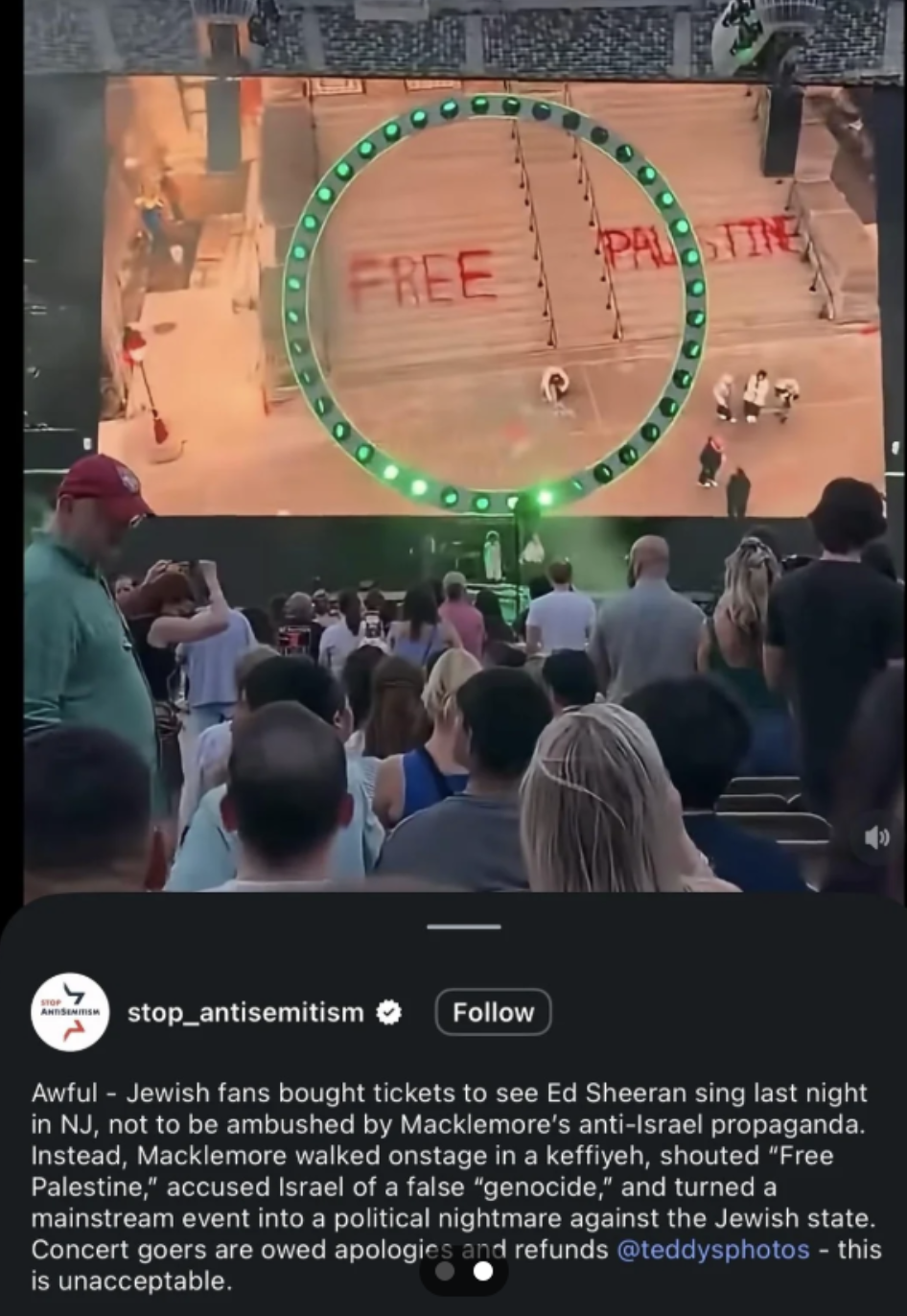
So what exactly did Pink agree with? That “Free Palestine” was offensive? That Macklemore shouldn’t have mentioned Gaza at a concert? That genocide was a false accusation? That Ed Sheeran should apologise? I have no idea, and that is the PR problem. If you are going to enter one of the most sensitive subjects in the world in front of millions of people, I think you should at least use your own words. When you repost somebody else’s argument, you don’t just borrow their conclusion. You inherit their language and their problems too.
“Who the fuck is doing their PR?”
Whenever a celebrity posts something spectacularly ill-advised, like Pink did. I always see some version of this in the comments: “Who is doing their PR?” As somebody who actually does this job, I always find it quite funny because the reality is that we don’t control people.
I’ve had clients who wouldn’t dream of giving me their Instagram password because their DMs are private. At the other end of the scale, I’ve worked with people who know they can be a bit of a loose cannon when they’re angry and deliberately don’t keep their own login details because they don’t trust themselves with them. My job isn’t to confiscate a grown adult’s phone. It’s to build enough trust that they ask me, “Can I post this?” before they do.
Sometimes my answer involves careful advice about wording. Sometimes it is simply: “I think that would be really fucking stupid. Please don’t post it. It will come back and bite you in the arse.” Usually they listen. Sometimes they don’t. When they don’t, my diary tends to become considerably busier.
So I have absolutely no idea what Pink’s PR team said about this, or whether she asked them at all, and I certainly wouldn’t automatically blame them. But I would be amazed if an experienced reputation adviser looked at that exact repost, its wording, the subject matter and an audience of nearly twelve million people and thought, “Yep, great idea.” Having PR advice and following PR advice are two very different things.
Twelve million followers is not a group chat
This is something I talk about with clients quite a lot. I oversee social platforms with audiences of more than 30 million people, and one of the things I regularly remind people is just how enormous those numbers actually are. On a screen, 20,000 followers is just a number. In real life, 20,000 people can fill an arena. Some public figures can gain that many followers in a day.
I sometimes ask clients to imagine standing in the middle of that arena, microphone in hand, with 20,000 real people looking back at them. Would you still be comfortable saying what you are about to type into your phone? Now multiply that audience hundreds of times over. It sounds slightly ridiculous, but it is a useful way of making an online number feel human again.
Pink has around 11.8 million Instagram followers, roughly the population of Belgium. Obviously every follower will not see every Story, but that is still an extraordinary communications platform. One tap on a phone can potentially put an opinion in front of more people than most of us could properly visualise.
I don’t think that means celebrities should stay away from politics or human rights. Quite the opposite. If you have an enormous platform and genuinely believe something matters, you are entitled to use it. Macklemore did. But having that kind of reach comes with responsibility. There is a difference between saying something around a dinner table and broadcasting it to millions of people, particularly when the subject is as serious as genocide, war or antisemitism. “It was only an Instagram Story” doesn’t really work when your Instagram Story potentially has an audience the size of a country.
This is where it becomes an actual reputation problem for Pink
The thing I would be watching now isn’t how many angry comments Pink gets underneath her own posts. It is whether the controversy starts following her elsewhere. While researching this, I noticed that comments on Pink’s Instagram had been restricted. I don’t know when that happened or why, so I’m not going to pretend it was definitely because of this controversy. More interestingly, I started seeing Pink’s name underneath completely unrelated posts about Gaza, including news coverage showing Palestinian civilians and children, with people making comments along the lines of “Pink supports this”.
To be absolutely clear, Pink did not say she supports the suffering of Palestinian civilians, and it would be unfair to claim that she did. But this is how reputational damage can spread. The original story was “Pink criticised Macklemore”. For some people online, that has already started mutating into something much broader about what they believe Pink stands for. A contained controversy is people arguing underneath your post. A reputation problem is when your name starts appearing underneath somebody else’s post about something much bigger than you.
Pink then shared several more Instagram Stories about critics and “haters”, including messages about not letting “idiots” ruin your day and “If they want to paint you as the villain then pose”. She didn’t explicitly say those posts were about this controversy, so we cannot say they definitely were, but given the timing, people understandably made the connection…. Obviously. And that is another fairly basic crisis PR lesson: when something is already going wrong, you do not necessarily need to keep feeding it.
I’m not going to dramatically predict that Pink’s career is over or that millions of people will unfollow her, because there is no evidence for either. A few big names like Madonna and Katy Perry and unfollowed her, but we’ll have to see if it actually has a lasting effect. The more interesting reputational damage is much harder to measure. Somebody can still follow you, still listen to your music and still quite like you, but think slightly differently about you from that point onwards. There is no analytics dashboard that tells you when that happens, and that is exactly why it can be much harder to repair.
And then, for some reason, Boy George joined in too
As if there weren’t already enough people involved, Boy George decided his opinion was also required. Writing on X, he criticised “Free Palestine” slogans, described Ed Sheeran as having “no spine”, attacked Paloma Faith for supporting Macklemore by describing her as “about as political as a soggy tuna sandwich”, praised Pink and said he hoped Sheeran would eventually “address this issue”.
It is the phrase “address this issue” that interests me. What exactly is Ed’s issue? An artist on his tour expressed support for Palestinians and said he wanted human beings to be treated equally. People can disagree with Macklemore or argue that an Ed Sheeran concert wasn’t the place for it, but controversy existing does not automatically mean Ed needs to issue a statement.
There is also something increasingly strange about Boy George’s involvement in all of this. When he was a judge on The Voice, he was still relevant and very much part of mainstream entertainment. That faded over the years. By the time he appeared on I’m a Celebrity, he was arguably doing what that programme has become fairly famous for: giving celebrities whose mainstream relevance has slipped a chance to put themselves back in front of a huge audience. More recently, though, he seems to have found another source of attention through becoming extremely vocal in his support for Israel, particularly around and since Eurovision.
And he has really gone hell for leather with it. He is now releasing AI-assisted pro-Israel music, posting it on X and being met by this strange new audience telling him how beautiful it is. I find the whole thing bizarre. This is Boy George, somebody who actually made brilliant, distinctive pop music. Now I find myself imagining him sitting there writing prompts for an AI music generator along the lines of “make me an emotional song supporting Israel” and uploading the result. Listen to the lyrics and it is not particularly difficult to imagine ChatGPT having a hand in writing them.
There is something almost comically dark about the feedback loop. He posts increasingly political content, this new audience enthusiastically rewards it, and I can see how that might start to feel like renewed relevance. But let’s be honest, I suspect Boy George would trade this strange popularity on X for proper mainstream relevance again in a heartbeat. His career choices suggest he still wants that. You don’t go on I’m a Celebrity or keep putting yourself in front of huge mainstream television audiences because you have no interest in being part of mainstream culture.
That is why, from a reputation perspective, I think he is digging himself into quite a hole. The more aggressively he makes this one highly divisive issue part of his public identity, the harder he potentially makes himself to book for the mainstream television, media and brand opportunities he has spent years trying to remain part of. A very vocal audience applauding everything you post can feel enormous when you are looking at your notifications, but it is not necessarily an audience that can sustain the wider career you actually want.
Eurovision itself is a whole separate PR case study, and frankly I could write another article on that alone. Its handling of Israel has attracted enormous backlash, and I think it would be naive to ignore the perception among a significant part of its audience that Israel has been afforded treatment and protection that other delegations would not receive. Whether Eurovision would agree with that characterisation is another matter, but reputationally the perception exists, and the broadcaster boycotts and wider controversy demonstrate how serious that problem has become.
Boy George seems to have come out of that environment with a new, highly engaged audience and then doubled down repeatedly. Maybe that gives him a temporary burst of attention. My prediction is that the attention will be considerably shorter-lived than the public identity he is building around himself now.
Which is particularly depressing because I fucking love Karma Chameleon.
So who actually has the PR problem?
Hilariously, after all of this, I think the person who has actually created a PR problem for themselves is Pink.
Macklemore said what he wanted to say, explained why he said it and has been saying broadly the same thing for years. Ed Sheeran, meanwhile, has a fairly simple decision to make now: do absolutely nothing. The outrage has happened, the people who were angry have been angry, and unless something materially changes, I genuinely think the smartest thing his team can do is crack on with the tour.
In fact, removing Macklemore now would probably create a much bigger problem for Ed. It could make him look weak, inconsistent and as though he was perfectly happy for Macklemore to perform until some people complained. It would also restart a story that will otherwise probably move on. From a crisis PR perspective, sometimes the answer really is that boring: don’t panic, don’t manufacture another headline and carry on.
I hope they do exactly that and the rest of the tour goes brilliantly.
Pink, on the other hand, had no problem to begin with. It wasn’t her tour, nobody was asking for her opinion and there was nothing she needed to defend. She voluntarily walked into somebody else’s controversy, shared an incredibly loaded post with nearly twelve million people, didn’t properly explain what she meant and has now created an association with herself that is already travelling beyond the original Macklemore story.
So, rather hilariously, the person who had nothing to do with the original controversy is the one I think has fucked up the most from a PR perspective. And if there is one useful lesson in this entire ridiculous story, it is probably that: you do not have to attend every argument you are invited to, particularly when nobody actually invited you.