
What press wires actually are, and what they are not [Q&A]
Press wires are one of the most misunderstood tools in public relations. They are often treated as a shortcut to credibility or a way of buying legitimacy, when in reality they function very differently to how most people assume.
They tend to appear in moments of pressure. A launch, a correction, a reputational issue, a legal situation. Someone suggests a press wire because it feels official, structured, and safe. The problem is that very few people are told what they are actually paying for, how the content is viewed by others, or what the limitations are.
This is a practical explanation of how press wires work, how they are perceived, what they can and cannot achieve, and why they are often misunderstood.
Why people misunderstand press wires
Much of the confusion comes from vague language. Distribution, coverage, reach and pick-up are often used interchangeably, despite describing entirely different outcomes. That ambiguity is rarely corrected, particularly when a client is already anxious and looking for certainty.
A press wire feels like action. It creates the sense that something formal has been done. That reassurance is often mistaken for impact.
What a press wire actually is
A press wire is a paid distribution service. You submit a press release to a platform. That platform reviews the content against its legal, editorial and compliance standards. If approved, the release is published across its syndicated network of sites and databases.
It is not pitched journalism. It is not editorial coverage. It is formal publication.
You are paying for placement within a distribution system, not for endorsement or interest.
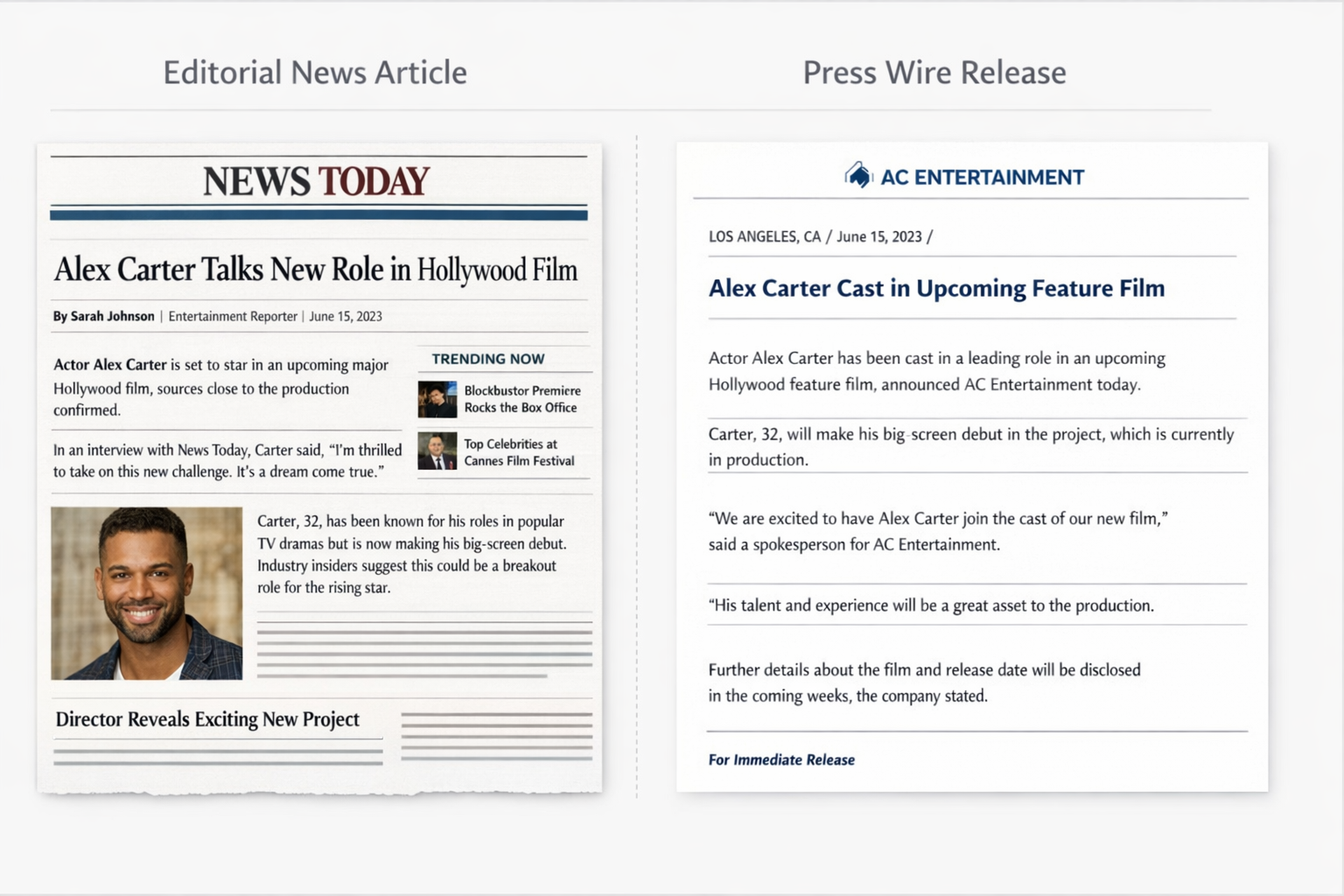
What does “a distribution system” actually mean?
In the context of press wires, a distribution system is a network designed to publish and circulate press releases, not to report on them.
When a press wire approves a release, it publishes it on its own platform and then automatically syndicates it across a large number of partner websites that exist to host wire content. These sites are not editorial newsrooms. They do not select stories, edit for narrative, or decide what is newsworthy. The content appears because it has been cleared and distributed, not because it has been chosen.
The system is built for scale and consistency. It allows the same statement to appear in multiple places at once, in a standardised format, with a clear timestamp and source. Journalists, analysts, lawyers and PR teams use these systems to monitor official statements, track timelines and verify what has been said publicly. Search engines also index this content, which is why wire releases often surface quickly in search results.
This is why a press wire release can look like a news article without actually being journalism. It is published information moving through a controlled network, rather than editorial coverage produced by a newsroom. The role of the system is to distribute approved content, not to assess its importance or credibility.
What kind of websites do press wire releases appear on?
When a press wire release is approved, it is published within the wire’s own network and then automatically syndicated to partner sites that are licensed to republish wire content. These sites are not selecting your story. They are hosting it as part of a feed.
In practice, this usually includes a mix of the following.
Financial and market data platforms
Releases often appear on finance-focused portals that pull in wire feeds for corporate updates, earnings statements, regulatory announcements and investor information. Examples include sites like Yahoo Finance and market-facing dashboards that aggregate corporate disclosures. These platforms exist to catalogue information, not to report on it.
Industry and sector aggregators
Many trade and industry websites automatically republish wire content related to their sector. This might include technology hubs, healthcare databases, energy platforms, or property and finance portals. The release appears because it matches a category, not because it has been editorially reviewed.
Regional and local news aggregators
Wire releases are frequently syndicated onto regional news sites, local business portals, and city-based “news” websites that run large volumes of wire content. These sites often look like traditional news outlets, but the content is largely automated and not journalist-written.
Press release hosting and archive sites
There are numerous websites whose primary function is to host and archive press releases. These sites exist specifically to surface wire content, often categorised by date, topic or company name. They are designed for record-keeping and discoverability rather than readership.
Subscription-only databases and monitoring tools
Behind the scenes, wire content also feeds into professional monitoring systems used by journalists, legal teams, PR firms and analysts. These are not public-facing news sites but searchable databases where official statements are tracked over time.
This is why a press wire release can appear in multiple places very quickly and look, at a glance, like widespread “coverage”. In reality, it is the same piece of content being replicated across a structured network that exists to distribute approved information at scale.
None of these platforms are endorsing the content. They are not validating it. They are hosting it because that is what the system is designed to do.
Do people know it’s a press wire release?
Yes, anyone familiar with media or PR can immediately recognise a wire release.
The formatting, language, syndication pattern and source attribution make it obvious. Journalists know. Editors know. Lawyers know. Other PRs know.
To the general public, it may look like “an article”, particularly when it appears on a news-style website, but it is not mistaken for investigative reporting or independent journalism by anyone working in the industry.
This is important because it means a press wire does not carry the same weight as earned coverage, even if it visually resembles it.
Is it the same as paying for a newspaper article?
No, it is a different category entirely.
A paid placement in a newspaper, advertorial or sponsored content is purchased space within a publication, often labelled as such. A press wire is a distribution platform publishing your statement across its own network and partners.
Neither is earned media, but they serve different purposes. Advertorials are designed to influence perception. Press wires are designed to formalise information.
Who actually reads press wire content
Press wire releases are read by journalists looking for confirmations, legal teams tracking statements, investors monitoring updates, analysts, researchers and PR professionals. They are also indexed by search engines and republished automatically by syndicated sites.
They are not widely read for enjoyment, discovery or storytelling. Journalists do not browse wires looking for features to write. They use them as reference points.
Why approval is stricter than people expect
Press wires have legal exposure. They are cautious by necessity.
Content is reviewed by real moderation teams. Claims must be defensible. Language must be restrained. Tone matters. Over the years, working with public figures and sensitive situations, I have had releases rejected, delayed, heavily edited, or refused outright. I have also had accounts restricted or removed when platforms decided they no longer wanted to handle certain types of content.
This is not unusual. It is part of how wires protect themselves.
Anything that reads as self-promotional, speculative, emotional or defamatory is likely to be declined.
What type of content works well
Press wires favour factual, neutral, verifiable content. Official statements, corporate announcements, legal clarifications, regulatory updates and timeline corrections tend to pass review.
The writing is often dry. That is intentional. The more boring the language, the more likely it is to be approved.
What almost never works
Thought leadership, opinion pieces, brand storytelling, reputation polishing, emotional defences and praise-heavy profiles are rarely accepted. Press wires are not interested in how good you are. They are interested in whether what you are publishing can be defended.
Can you just pay and publish instantly?
No.
Payment does not guarantee publication. Content can be rejected after submission, delayed, or sent back with required edits. Timelines are not fully within your control.
I’ve been using press wires personally for years, and even now I’m occasionally surprised by what gets declined. Sometimes the reasoning is perfectly fair. Other times it feels inconsistent, overly cautious, or simply doesn’t make much sense at all. I’ve also had entire accounts restricted or banned from using certain press wires altogether, not because of anything illegal or defamatory, but because a platform clearly did not want to be associated with a particular client or category of content.
That unpredictability is far more common than people realise.
This is why a press wire is not something you can just instruct someone to “get out” and assume it will be live within 12 hours. Sometimes it is. Often it isn’t. Reviews can take longer than expected, edits can go back and forth, and a release you thought was straightforward can suddenly stall without much explanation.
Experience matters here because writing for a press wire is not the same as writing a press release generally. Knowing how these platforms interpret risk, what language triggers pushback, and where the invisible lines sit is often the difference between something being approved smoothly and something quietly going nowhere.
How much do press wires actually cost?
Press wire pricing varies widely depending on the platform, geography, length of the release, and level of distribution.
At the lower end, you might pay a few hundred pounds for a short, local or niche release distributed within a limited network. These are usually tightly capped by word count and geography, and are often used for straightforward corporate announcements or small business updates.
At the mid-range, costs typically run into the low thousands. This is where most national or multi-region releases sit. You are usually paying for broader distribution, longer word counts, and access to more established syndication networks. This is also where approval standards tend to tighten, particularly around claims, tone and legal exposure.
At the higher end, press wire distribution can run into several thousand pounds per release. This is common for international distribution, financial disclosures, regulated industries, or situations involving public figures and higher perceived risk. At this level, pricing is influenced by jurisdiction, scrutiny, and the level of moderation involved, not just reach.
What you are paying for is not attention or coverage. You are paying for placement, moderation, distribution at scale, and the infrastructure that allows a statement to be published, timestamped, archived and indexed across multiple platforms at once.
The cost reflects risk, compliance and scale, not impact.
Press wires during crises
Press wires are frequently misused in crises. When emotions are high, they feel like a way to regain control. The issue is permanence.
Once published, a wire release is timestamped, indexed, archived, quoted and screenshot. Poor wording can create long-term reputational issues that outlive the original problem.
A press wire is not a temporary statement, it’s a record.
A quick warning on “guaranteed press” deals
This isn’t about selling my services, it’s about people understanding what they are actually being offered.
When you see ads promising “guaranteed press” for £700 or similar, what is usually being guaranteed is not editorial coverage. In most cases, it means a press wire release or, more often, a very cheap paid placement on a low-quality site. In some instances, those placements cost as little as £10 to £30. They technically count as publication, but they are not journalism.
That is why the price looks so low. It is not because the agency has found a shortcut to real media, it is because the fulfilment method is inexpensive.
This is usually made clear in the contract, if you know what to look for. Common wording includes phrases such as:
“Guaranteed media placement across partner or third-party publications.”
“Coverage may include paid, syndicated, or distributed content.”
“Press coverage refers to publication rather than editorial endorsement.”
Language like this gives the agency full flexibility to fulfil the promise via press wires or paid placements, while still meeting the terms of the agreement.
There is nothing illegal about this, but it is very different from what most people assume they are buying. If press is genuinely earned, it cannot be guaranteed. If it is guaranteed, the guarantee is almost always about placement, not coverage.
If a PR agency helps with a press wire, does their fee cover the cost of the wire itself?
No. In almost all cases, the press wire fee is separate.
When a PR agency supports a press wire release, what you are paying the agency for is their time, experience, judgement, and account access. That includes advising on whether a wire is appropriate, drafting the release in a way that has a chance of being approved, managing edits, handling moderation feedback, and deciding where and when it should be distributed.
The cost of the press wire itself is charged on top. That fee is set by the wire, not the agency.
Depending on how an agency operates, the wire fee may be invoiced to you directly by the platform, added to your next invoice, or billed in advance before distribution. The structure varies, but the principle is the same.
If an agency claims that the press wire cost is “included” without explaining what that actually means, it’s worth asking for clarity. Transparent agencies will always be clear about what is agency time and what is third-party cost.
Press wires and search results
Wire releases can surface very quickly in search results, particularly for brand names or individual name searches. With the right strategy behind them, they can temporarily dominate page one and help establish an official version of events. Used properly, they can be genuinely useful in shaping what someone sees when they search in the short term.
That said, they are not a silver bullet. Press wire pages do not carry the same authority as established media outlets. If you are dealing with sustained coverage from major publications, or trying to compete with ongoing editorial reporting, wire releases will not outrank it long-term. Their domain authority is simply too low to compete with real journalism once the initial surge settles.
Where press wires tend to work best is in situations where there is little or no existing media coverage. For businesses, founders, or organisations that are not regularly written about, a wire release can fill a vacuum. Someone Googling the company name is unlikely to distinguish between a wire-hosted page and an earned article, particularly when it appears on a professional-looking site and reads in a formal, neutral tone.
In those cases, press wires can be very effective at shaping first impressions and providing context, as long as the content is factual, restrained and compliant with the platform’s rules. They are less about overpowering negative press, and more about setting a baseline narrative where none previously existed.
As with everything else, they work best as part of a wider strategy. On their own, they are limited. Used carefully and in the right circumstances, they can be a useful supporting tool.
When press wires make sense
Press wires are useful when you need something formal, factual and controlled on the public record. They are effective for documentation and clarity.
They are ineffective when used as a substitute for earned media, reputation repair or strategic communication.
Do I personally recommend using a press wire?
They absolutely have their place.
For certain clients, particularly those in business, dealing with legal situations, or needing something formal and factual on the public record, press wires can be genuinely useful. They are often appropriate where accuracy, control and documentation matter more than visibility or storytelling.
That said, they are rarely my first choice.
Generally speaking, I will always prioritise trying to secure earned coverage with a journalist at a respected publication. An exclusive, a properly reported piece, or even a short mention written independently carries far more credibility and long-term value than any wire release ever will.
Press wires tend to sit alongside that work, not instead of it. They are supporting tools. They can help formalise information, provide clarity, or sit in the background as part of a wider strategy, but they are not a substitute for real media engagement.
Used deliberately and with realistic expectations, they can be worthwhile. Used as a shortcut, they usually disappoint.The practical reality
Press wires are not about attention. They are about control. Control over wording, timing and what exists publicly as an official statement.
They are precise tools, they are not shortcuts.
Quick answers, for people who scroll
Are press wires paid?
Yes.
Is it obvious they’re press wire releases?
To anyone in media, yes.
Is it the same as real press coverage?
No.
Is it the same as advertorial or sponsored content?
No.
Can journalists see press wire releases?
Yes.
Do journalists have to act on them?
No.
Can content be rejected after payment?
Yes.
Can publication timelines be guaranteed?
No.
Do flattering or promotional pieces work?
Rarely.
Are press wires useful in crises?
Sometimes, with care.
Do press wires fix reputation issues on their own?
No.
Do they help with search visibility?
Temporarily.
Can they compete with major media long-term?
No.
Are they useful when there’s no existing press?
Yes.
Do people Googling a business know it’s a press wire?
Usually not.
Are “guaranteed press” deals usually earned coverage?
No.
Does “guaranteed press” usually mean placement?
Yes.
Are cheap guaranteed press deals a red flag?
Yes.
Do agencies usually cover press wire fees?
No.
Is the press wire fee separate from agency fees?
Yes.
Are press wires a strategy on their own?
No.