
The lie of “we didn’t mean harm”: how online bullying avoids accountability
There is a persistent belief that online bullying culture is something we have already confronted, named, and begun to move past. From where I sit professionally, that belief is not just wrong, it is dangerously complacent. The behaviour has not softened. It has not become more self-aware. It has become more confident, more systematised, and more insulated from consequence.
I work in crisis PR. I am brought in when reputations are under attack, often at moments when people are already under intense personal and professional pressure. What I am seeing more frequently now is not legitimate scrutiny or informed criticism, but anonymous speculation being treated as fact, gossip being elevated to evidence, and deeply hostile narratives being built entirely on repetition rather than proof.
Word of mouth is not evidence. “People are saying” is not a source. Personal grievance, jealousy, resentment, or a failed relationship does not become credible simply because it is repeated loudly or often. Offline, these things would collapse immediately. Online, they are allowed to metastasise.
That is not a glitch in the system, it simply is the system.
The human cost is deliberately ignored
One of the most corrosive aspects of online bullying culture is the way it strips situations of human context. People become flattened into characters, and characters can be attacked without restraint. Complexity disappears. Proportionality disappears. Curiosity disappears. What remains is certainty, usually delivered with extraordinary confidence by people with no actual knowledge of the individual they are discussing.
I regularly sit with clients who are incredibly distressed by what they are seeing written about them online. Not because they cannot handle disagreement, but because what is being said is often extreme, relentless, and deeply personal. Appearance, finances, mental health, relationships, and family are all treated as fair game. In some cases, I have seen accusations that are genuinely sickening, made with no evidence whatsoever, by people hiding behind usernames.
The cruelty does not feel abstract when your name is attached to it. It affects sleep, work, confidence, relationships, and mental health. Yet the people participating in these spaces continue to insist that it is harmless, that it is “just the internet,” or that public visibility somehow forfeits the right to basic decency.
Anonymity does not make people more honest, it makes them less human.
When bullying culture panics, it rewrites itself
Very sadly, YouTuber Adam the Woo has passed away. We do not know why, and speculation is neither appropriate nor necessary here. His death matters not because of its cause, but because of what it immediately exposed.
The screenshots below come from online spaces that had spent significant time mocking, criticising, and fixating on him. They are not outliers. They are representative.
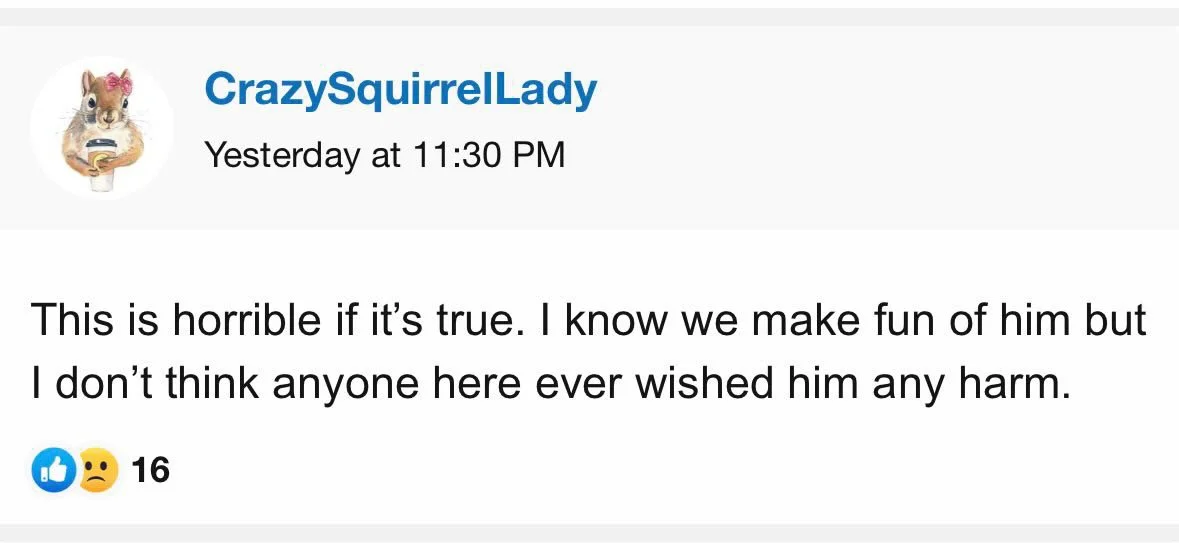
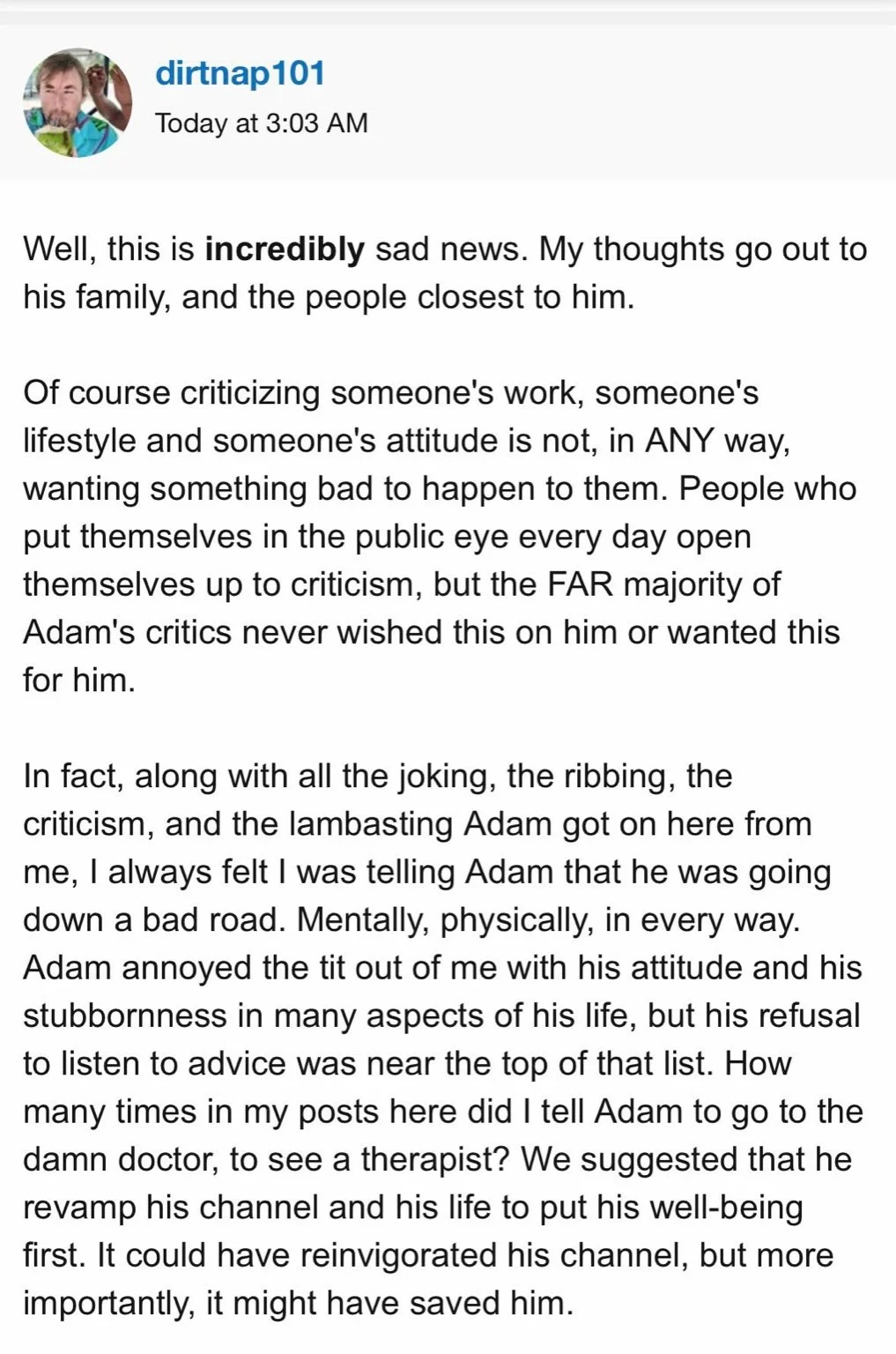
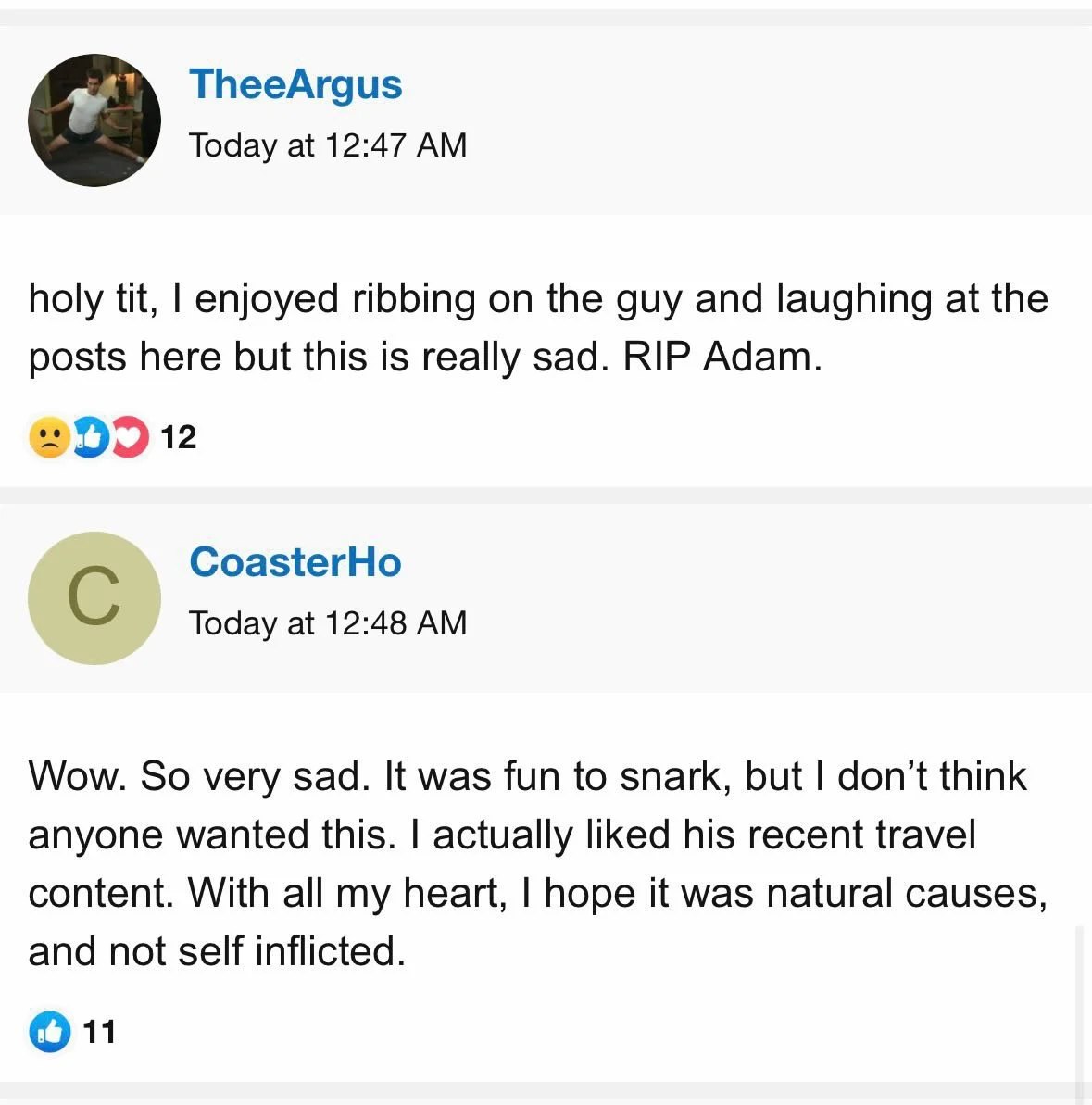
What is immediately striking about these comments is that they do not deny bullying took place. Several commenters openly acknowledge it. They admit to “ribbing,” “snarking,” “making fun,” or “lambasting.” That admission, however, is immediately neutralised by what follows. Almost every comment introduces a qualifier designed to distance the speaker from responsibility.
We bullied him, but we didn’t want this.
It was just jokes.
No one wished him harm.
Criticism isn’t the same as wanting something bad to happen.
This language is not reflective., it is strategic. It allows people to concede behaviour while stripping it of consequence. Bullying is reframed as something technical rather than ethical, detached from impact. The focus quietly shifts away from the person who has died and onto reassuring the group, and themselves, that they remain good people.
One comment describes the bullying as “fun.” That single word is doing an extraordinary amount of work. It sanitises cruelty by reframing sustained mockery as entertainment, something communal and harmless. Snark culture relies entirely on this framing. It turns bullying into a leisure activity rather than a behaviour with consequences. The moment something serious happens, the word “fun” disappears, replaced by solemn concern, but the mindset that allowed it to be fun in the first place is never interrogated.
Another recurring theme is the insistence that no one “wanted this” or “wished him harm.” This is one of the most intellectually dishonest positions in online culture. Harm does not require intent. It requires repetition, scale, and dehumanisation. You do not have to wish someone dead to contribute to an environment that reduces them to a punchline, speculates about their mental state, and treats their life as content. The repeated emphasis on intent is not a defence, it is a way of avoiding responsibility for impact.
Perhaps the most condescending aspect of these comments is the retroactive reframing of bullying as concern. Several commenters imply that the mocking was actually a form of guidance or tough love, that people were “trying to help” or “telling him to get help.” This is empathy rewritten after the fact. Genuine concern does not come wrapped in derision, delivered publicly, and shared for entertainment. Recasting cruelty as care once it becomes uncomfortable is not compassion, it is self-protection.
Normally, I would blur usernames in screenshots like these. I used to. At this point, I am done protecting anonymous bullies from consequences they never once considered for the people they targeted. These users already hide behind usernames. The only thing anonymity protects here is their sense of impunity. Watching the tone shift from confident mockery to anxious backpedalling the moment accountability feels possible tells you everything you need to know about how fragile this behaviour actually is.
Anonymity does not create courage, it creates cowardice
I want to be clear about this, because it matters professionally. In several cases, I have taken the time to identify anonymous users who were relentlessly bullying my clients on forums like Tattle. Not to expose them publicly, not to threaten them, and not to retaliate, but to understand who they actually were and to reassure my clients that these voices were not powerful arbiters of truth.
In some cases, I reached out directly. Calmly. Privately. Simply asking them to stop, and asking why they felt compelled to behave this way.
Shocker, they absolutely shit themselves.
The reaction is always the same. Immediate panic. Sudden politeness. A frantic shift in tone. People who were bold, cruel, and morally righteous behind usernames like “crazysquirrelady” suddenly become very concerned about consequences the moment anonymity is pierced. They do not stand by what they have said. They do not defend it as fair comment. They certainly do not maintain the confidence they had while hiding behind a cartoon avatar and a burner email address.
And this is where the hypocrisy becomes genuinely funny, if it weren’t so bleak.
These are people logging in anonymously, often daily, to dissect strangers’ lives, appearances, careers, relationships, and mental health, while choosing to spend their own time doing exactly this. Sitting behind a screen, under a name like “buttercupfizz” or “crazysquirrelady,” obsessively mocking people who are, for better or worse, actually out in the world living their lives. The audacity required to judge how others live, while this is how you choose to spend your own time, is staggering.
What seems to completely escape them is how weird this behaviour looks once it’s dragged into the light.
I’m a very kind person. I don’t say that lightly. I’m respectful, measured, and patient almost to a fault. But when it comes to anonymous online bullies, I genuinely lose all interest in being polite about them. Because there is nothing noble, clever, or insightful about this behaviour. It is bottom-of-the-barrel cruelty dressed up as commentary, and the recent backpedalling we’ve all witnessed only exposes how fragile their moral confidence really is.
What this very sad death has highlighted is just how anxious these people are about accountability. They are already rewriting their behaviour before they even know the facts, because on some level they understand that what they’ve been doing is indefensible. They are panicking at the idea that sustained bullying might actually have consequences, and that panic tells you everything.
So let me be very clear, for anyone reading this who posts anonymously on Tattle, Mumsnet, Reddit, or similar forums. Yes, you are damaging people’s mental health. I can confirm that to you directly, through multiple clients, and through people who have reached out to me privately after being targeted. You are not “just analysing.” You are not “just discussing.” You are bullying. You are harassing. And you are wrong about the people you talk about the vast majority of the time.
I have yet to see anything even remotely accurate written about any of my clients in these spaces. What I do see is projection, resentment, jealousy, and a desperate need to feel superior, temporarily, from behind a screen.
In several cases, I identified users not to punish them, but to help my clients sleep at night. To show them that the faceless hostility wasn’t some vast, unknowable threat, but one very ordinary person with a lot of time and very little self-awareness. Because anonymity is what makes this behaviour feel sinister. Once you put a face to it, the illusion collapses.
And perhaps that’s why these people react with such fear when they are identified. Because deep down, they know exactly how it looks. They just don’t want to look in the mirror.
I genuinely hope that we move towards a future where some form of identification or accountability is required in these spaces. Not to silence people, but to force a basic level of responsibility. Because as it stands, the people doing the most damage are also the least willing to own it.
And watching them scramble, backpedal, and panic the moment that shield slips is, frankly, the most honest thing these forums have shown us in years.
Journalism is no longer acting as a brake on this behaviour
One of the reasons online bullying culture has become so confident is that it increasingly mirrors what it sees in mainstream journalism. There was a time when journalism acted as a corrective force, where rumour was interrogated, sources were tested, and claims were held back until they could be substantiated. That role is weakening, and the consequences are serious.
I am seeing more and more articles, long-form features, and even so-called investigative documentaries that rely heavily on word of mouth. Anonymous or loosely attributed sources are treated as credible by default, even when there is no clear explanation of how they would realistically know the information they are sharing. Assertions are framed as implication rather than fact, allowing devastating claims to land without ever being properly tested.
What feels particularly reckless is the absence of even the most basic pause for motive. I wish more than anything that people, journalists included, would take ten seconds to ask obvious questions. Why would someone who has not spoken to the person they are accusing for ten or twenty years have detailed, intimate knowledge of their behaviour now? Why is their version of events being treated as authoritative? What incentive might they have to speak out at this moment?
Jealousy exists. Resentment exists. Failed business relationships exist. People fall out. People feel slighted. People enjoy relevance, attention, or revenge. None of that automatically makes someone a liar, but it absolutely makes motive something that should be examined, not ignored. Treating every hostile voice as morally pure simply because it aligns with a dramatic narrative is not journalism, it is negligence.
Word of mouth is not evidence.
Repetition is not verification.
And distance from an individual does not magically turn opinion into fact.
What is particularly troubling is how often the other side of a story is either minimised or excluded entirely, even when evidence has been provided. I have worked on cases where documents, timelines, correspondence, and independent verification have been shared with journalists, only for them to be ignored because they complicate the story. Not because they are weak, but because they disrupt a clean narrative.
There is a growing acceptance in parts of the media that as long as something feels true, it can be treated as true. Emotional weight replaces factual rigour. Suspicion replaces proof. This is how hit pieces become normalised, not because the evidence is strong, but because the framing is persuasive.
The most concerning examples are documentaries marketed as serious investigations, where viewers are led carefully toward a conclusion while contradictory material is quietly sidelined. Audiences are rarely told that another version of events exists, or that claims were disputed with evidence. What they are given instead is tone, implication, and selective emphasis. The authority of the format does the rest.
I have personally reached out to journalists to correct factual inaccuracies, politely and with evidence attached. In several cases, the response has been a flat refusal. Not a discussion, not a review, just no. The message is implicit but clear. The truth is inconvenient, and nothing is allowed to get in the way of a good story.
This is where the damage becomes systemic. When journalism signals that narrative matters more than verification, anonymous spaces feel vindicated. If a published outlet can imply wrongdoing without proof, why shouldn’t a forum user? If a documentary can exclude evidence to preserve momentum, why should anyone else bother with balance?
Journalism cannot credibly condemn online bullying while quietly adopting the same logic. If it wants to retain moral authority, it has to slow down, question motive, test sources properly, and be willing to say “we don’t know.” It also has to be willing to correct the record when facts undermine a compelling narrative.
Because once the distinction between allegation and evidence collapses, the consequences extend far beyond the page.
“Be kind” only ever arrives once it is too late
We have seen this cycle before, most notably after the death of Caroline Flack. The phrase “be kind” briefly flooded public discourse, accompanied by collective regret and outrage. And then, quietly, nothing changed.
Kindness continues to be treated as retrospective, something we perform after the damage is already done. It is never applied while someone is actively being dismantled in real time. That is why the phrase now rings hollow. It has become a post-mortem ritual rather than a value.
Guilt is not the issue... Humanity is.
Another uncomfortable truth is that online culture no longer allows room for imperfection. Whether someone is innocent, flawed, or has made genuine mistakes often becomes irrelevant. There is no proportionality, no allowance for growth, and no interest in context. Punishment becomes unlimited, permanent, and crowdsourced.
Even when someone has done something wrong, the idea that they remain a human being with complexity seems to disappear. Lives are flattened into narratives. Narratives are attacked until nothing recognisable remains.
This absence of humanity is what makes online pile-ons so dangerous. They encourage certainty without responsibility and punishment without restraint.
Accountability is the only thing that changes behaviour
This is not an argument for censorship. It never has been. It is an argument for accountability, which is something very different and increasingly absent online. Anonymous accusation without evidence should not be consequence-free. Bullying repackaged as entertainment should not be normalised. And platforms that knowingly enable sustained harassment should not be allowed to wash their hands of the outcomes.
From a professional standpoint, the current situation is frankly indefensible. In my work, I should be able to engage with these platforms in a meaningful way. If someone is making serious, damaging claims about my client, I should be able to contact the platform directly, present evidence, and expect a proper review. Not a generic response, not silence, and not a refusal because controversy drives engagement. If something is demonstrably false, malicious, or misleading, it should be removed. That should be standard procedure. The fact that it is not tells you exactly where responsibility currently sits.
Equally, it is not unreasonable for platforms that host this kind of content to require identification at the point of sign-up. I am not asking to publicly expose anyone’s documents, and I have no interest in intimidation or retaliation. But anonymity should not function as a permanent shield for people making serious allegations about others. If claims are being made, there should be a route, through the platform, to a real name and a real point of contact so those claims can be challenged properly. At the moment, the system is designed to protect the accuser at all costs, regardless of whether what they are saying is true.
What makes this even more dangerous is that these forums do not exist in isolation. Sites like Tattle, Mumsnet, and Reddit are indexed by Google. They carry authority. They rank highly. When someone searches a person’s name, these threads often appear prominently, sometimes above factual reporting. A significant part of my job now involves trying to bury unverified forum gossip from the first page of search results, because once it is there, it is treated as legitimate by readers, employers, brands, and partners.
This problem is accelerating. AI systems are beginning to ingest this material and treat it as source data. I am already seeing anonymous forum comments surface in AI summaries as if they are established facts. Rumour is being laundered into perceived truth through repetition and technical authority. That is not a theoretical risk. It is already happening.
Journalism also needs to be held to account here. I am seeing more hit pieces presented as reporting, built on implication rather than evidence, and increasingly on word of mouth. Assertions are allowed to stand because they are dramatic, not because they are true. And nothing, it seems, gets in the way of a good story quite like the truth.
I have personally provided journalists with documents, timelines, correspondence, and verifiable facts, only to see them ignored because they complicate the narrative. Not challenged. Not disproven. Simply sidelined. Not because the evidence is weak, but because the story works better without it. The implication remains intact, the headline still lands, and the damage is done.
Clicks, traction, and a pat on the back from your editor are not worth destroying someone’s mental health or reputation. And if they are, that is something worth taking a long look at. Journalism does not get a free pass to behave like an anonymous forum simply because it has a masthead and a commissioning budget. If allegations cannot be substantiated, they should not be amplified. If evidence is provided, it should be examined, not ignored because it disrupts a cleaner storyline.
Unless accountability exists before tragedy rather than after it, this cycle will continue. The bullying will carry on. The pile-ons will escalate. And the moment something serious happens, the same ritual will play out again. The backpedalling. The sudden concern. The insistence that no one meant for it to go this far.
Every time, the same phrase is offered up as a defence.
We didn’t want this….
The truth is that wanting it has never been required. Repetition, anonymity, institutional indifference, and a willingness to look the other way have been more than enough.