
BrewDog’s £33m sale: what really went wrong and the PR lesson founders keep ignoring
For nearly two decades BrewDog managed something most consumer brands never achieve. It turned a product into a personality.
Founded in 2007 in Aberdeenshire by James Watt and Martin Dickie, the company deliberately positioned itself as the punk rebellion against the traditional brewing industry. It mocked corporate beer giants, used provocative marketing, and built a brand that felt more like a movement than a drinks company. Punk IPA became the symbol of that movement, and throughout the 2010s BrewDog was widely seen as the face of the craft beer boom in the UK.
The company grew quickly. Breweries opened overseas, bars spread across Britain and internationally, and the founders themselves became part of the brand narrative. BrewDog wasn’t just selling beer, it was selling disruption.
But disruption works best during the growth phase. When the economic cycle turns, the same strategy can become a liability surprisingly quickly.
The £33m deal that dismantled the empire
BrewDog’s UK and Irish assets have now been sold to the US cannabis and drinks firm Tilray for £33m.
The deal includes the BrewDog brand, intellectual property, UK brewing operations and a small number of “strategic” bars in the UK and Ireland. Around 733 jobs have been preserved within that structure.
However, the rest of the bar estate has not survived the transaction. Thirty-eight bars have closed immediately, resulting in 484 job losses.
In practical terms, the deal represents a partial dismantling of the BrewDog business model. Tilray has acquired the parts that still carry brand and production value, while the more expensive hospitality infrastructure has largely been abandoned.
This is a fairly typical outcome in distressed acquisitions. Buyers rarely purchase the full structure of a struggling company. They purchase the pieces that can still generate profitable growth.
From Tilray’s perspective the attraction is obvious. BrewDog remains one of the most recognisable craft beer brands in Europe. Acquiring that intellectual property gives Tilray instant credibility in the craft segment alongside its existing portfolio of breweries and cannabis-adjacent beverage products.
But it also marks the end of BrewDog’s attempt to operate as a global bar and hospitality empire.
A valuation collapse that tells its own story
Perhaps the most striking detail in the entire situation is the price.
At one stage BrewDog was projected to reach a valuation of around £2bn through a potential stock market listing. The £33m sale represents a collapse of roughly 97% from those expectations.
That number alone tells you that the issue here is not simply short-term trading conditions. It reflects a fundamental reassessment of the company’s business model.
During the craft beer boom BrewDog expanded aggressively, building breweries overseas and opening a vast global bar network. The ambition was to transform the company from a brewery into a lifestyle brand with physical venues acting as brand showcases.
That approach can work, but it comes with enormous operational risk.
Hospitality is capital intensive, labour heavy and highly sensitive to economic conditions. When energy costs rise, rents increase and consumers begin cutting discretionary spending, large bar estates become extremely difficult to maintain.
The same venues that symbolised BrewDog’s success during its expansion phase became some of its largest financial liabilities once the market tightened.
The uncomfortable reality facing Equity for Punks investors
Another group affected by the sale are the more than 200,000 retail investors who bought shares through BrewDog’s “Equity for Punks” crowdfunding scheme. For years the scheme was promoted as a way for ordinary drinkers to become part of the BrewDog story, encouraging investors to see themselves not just as shareholders but as participants in a rebellion against traditional beer companies.
Many of those investors believed the shares could eventually become highly valuable if BrewDog floated on the stock market. Under the administration process, however, those investors will receive nothing.
From a corporate finance perspective this outcome is entirely predictable. In distressed sales, creditors and certain investors are paid before ordinary shareholders. Retail equity sits at the bottom of that hierarchy.
From a brand perspective, however, the optics are brutal. When customers were encouraged to see themselves as part of the movement, discovering that they were effectively last in line financially creates a very different emotional response. It is a reminder that marketing narratives and capital structures rarely operate according to the same rules.
The founder effect
BrewDog’s identity has always been closely linked to its co-founder James Watt. His outspoken interviews, combative marketing style and willingness to attack competitors helped propel the brand into the spotlight. Media outlets love founders who behave like characters, and Watt’s disruptor persona provided a steady stream of headlines.
Founder-led brands can be extremely powerful in that sense. They give journalists a story and create a human face for the company. But they also come with an additional reputational risk.
When the founder becomes inseparable from the brand, audiences inevitably interpret the company through that individual’s behaviour and tone.
To be clear, BrewDog’s financial problems are not the result of Watt being irritating on the internet. They are the result of expansion decisions, cost structures and a difficult hospitality market. But personality does influence how the public reacts when those business problems emerge.
So bloody tone-deaf
In recent years James Watt and his wife, Georgia Toffolo, have built a very visible online presence together, particularly across TikTok and LinkedIn. The intention seems to be playful and self-aware. In practice it often lands somewhere closer to hard watch.
One widely shared TikTok, filmed on a luxury island holiday, used the familiar “passing the phone” trend. The jokes revolved around things like jumping into a higher tax bracket by getting married, admiration for political figures such as Margaret Thatcher and Boris Johnson, and various references to wealth and status.
The strange part is the assumption that people watching will find this universally hilarious.
TikTok is overwhelmingly used by younger audiences, many navigating rising rents, stagnant wages and a fairly relentless cost-of-living crisis. Watching a couple joke about tax brackets from a villa abroad while expecting everyone to laugh along feels less like self-aware humour and more like a small window into a completely different economic universe.
Then there was the engagement announcement on LinkedIn, which framed their relationship almost like a corporate partnership agreement. LinkedIn is toe-curling most of the time anyway, but that post really did feel like the cherry on top.
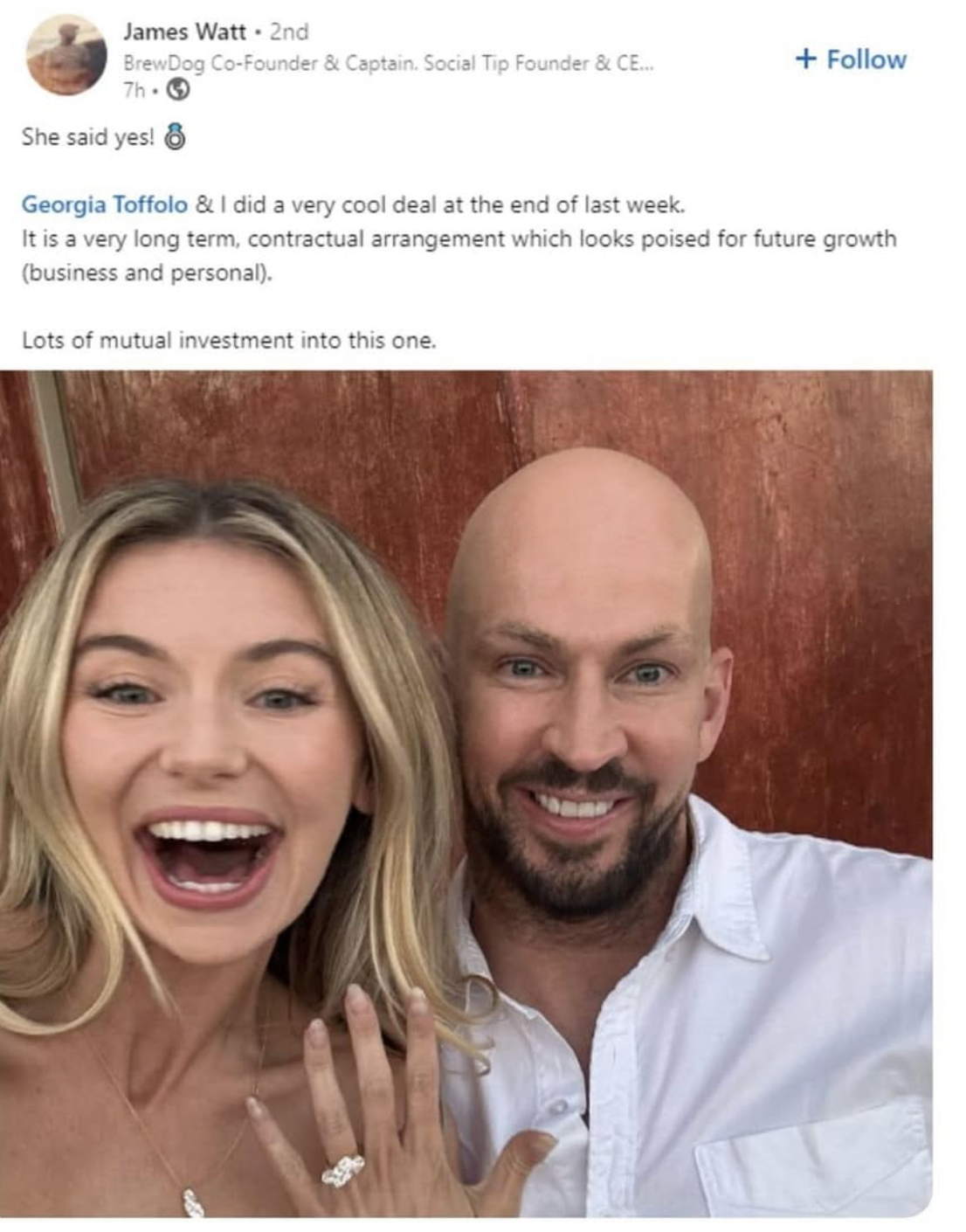
None of this caused BrewDog’s financial problems. But it does illustrate how easy it is for founders to drift into a tone that feels detached from the people actually watching them.
And once that perception settles in, every new post tends to reinforce it.
The lesson most founders ignore
The BrewDog story ultimately is not about a TikTok video or a cringeworthy LinkedIn post. It is about what happens when rapid expansion, strong founder branding and changing market conditions collide.
Businesses restructure all the time. Markets tighten, strategies overreach and companies shrink back to survive. That part of the story is entirely normal. What determines the reputational outcome is whether leadership recognises when the narrative needs to evolve.
During growth phases, loud personalities and bold messaging can accelerate brand awareness enormously. The founder becomes part of the brand’s appeal, and confidence is often interpreted as vision. But when circumstances change, the same tone can suddenly feel out of step with the environment around it.
Confidence builds brands. Self-awareness tends to protect them.
BrewDog’s rise showed how powerful founder-driven branding can be. Its current situation is a reminder that once the founder becomes part of the story, the public will judge the business through that personality just as much as through the balance sheet.