
A communications lesson hidden inside a Mother’s Day email
Every year the same retail moments appear in marketing calendars with complete predictability. Valentine’s Day, Mother’s Day, Father’s Day, Christmas. Campaigns are written weeks in advance, subject lines are tested, and millions of automated reminders are scheduled to land in inboxes at exactly the right moment.
From a commercial perspective, this makes complete sense. Mother’s Day drives enormous spending across cards, flowers, lunches and gifts. For companies built around greetings and personal messages, reminders are not optional, they are the business model. Businesses promote around these moments because they work. A company like Moonpig prompting people to remember the day is simply doing what the business is built to do.
Occasionally, however, a piece of marketing language stands out in a way that invites a closer look.
The Moonpig email
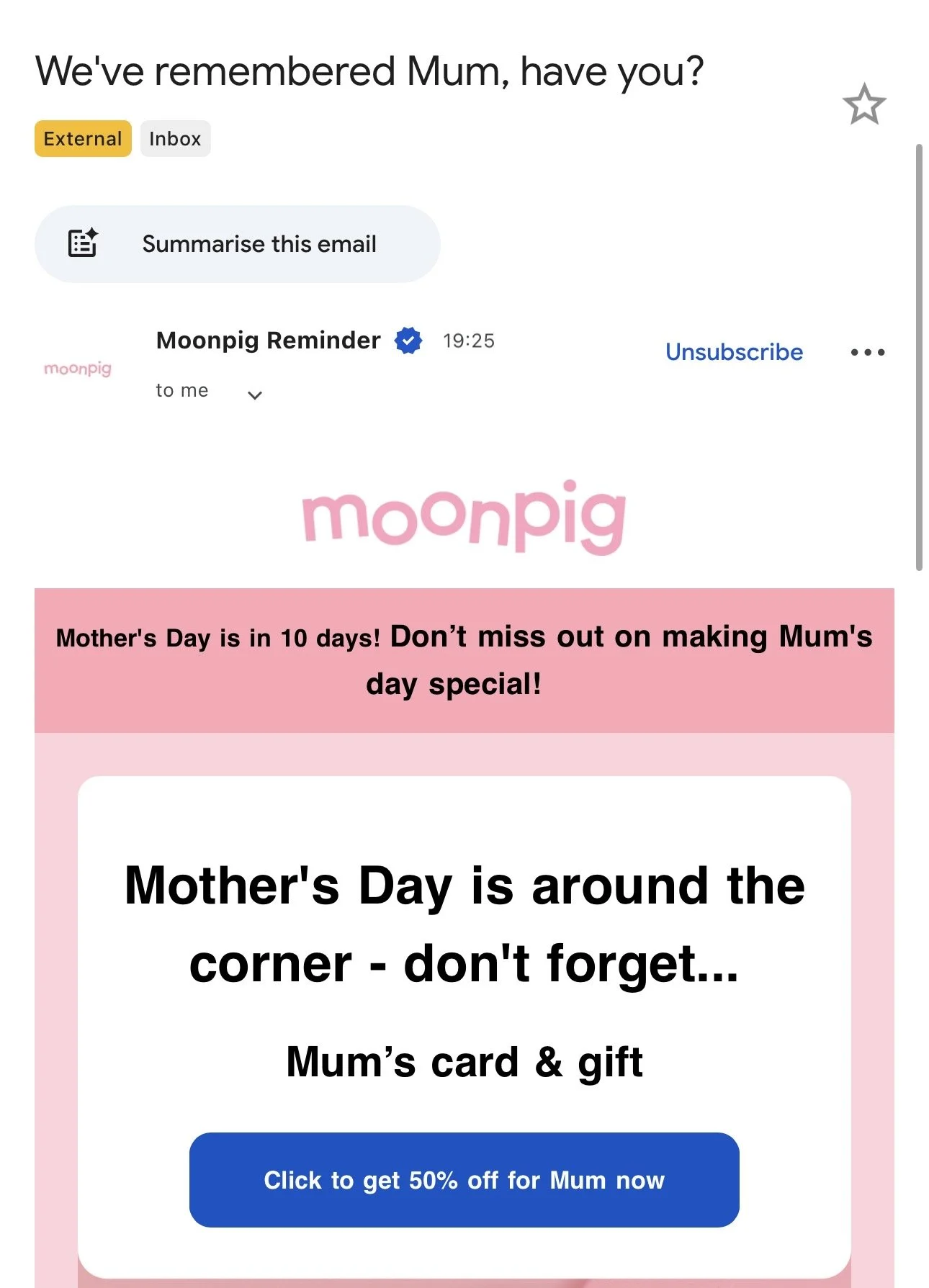
Recently an email from Moonpig landed in my inbox with the subject line: “We’ve remembered Mum, have you?”
For readers outside the UK, Moonpig is one of the country’s largest online greeting card companies. The entire business is built around reminders for birthdays, anniversaries and occasions like Mother’s Day, allowing people to quickly personalise and send cards online. My immediate reaction was genuine surprise. I think I actually scoffed and said “holy shit” out loud. Not because I was personally offended, but because the phrasing is remarkably blunt when you pause and think about what it implies.
My mum passed away a couple of years ago. Personally, I am fortunate in that reminders like this do not derail my day. Mother’s Day promotions appear everywhere at this time of year, in shop windows, restaurants, supermarkets and across social media, and that is simply part of the world we live in. Life continues and businesses continue to advertise around cultural moments.
At the same time, I am very aware that for a significant number of people that sentence would land very differently, and could be genuinely upsetting.
A brief note on modern sensitivity
Before going any further, it is probably worth clarifying something. I am not someone who believes the world should contort itself into impossible shapes to avoid offending me or anyone. If anything, parts of modern online culture feel as though they have swung too far in the opposite direction. We now live in an environment where perfectly normal language is sometimes treated as though it needs to be softened or disguised. On TikTok, for example, people routinely avoid saying the word “murdered” and instead use phrases like “unalived”, as though changing the wording somehow makes the reality itself less uncomfortable. I often find myself wondering why adults have collectively started speaking as though we are addressing children. The whole practice of covering or disguising words, whatever term people want to use for it, has started to feel strangely childish.
The common explanation is that this is done for algorithm reasons, that certain words supposedly trigger penalties or reduce reach. Yet that theory has been tested repeatedly and shown to make little difference in practice. Regardless, it has led to a situation where perfectly normal conversations are now wrapped in awkward language and trigger warnings for topics that are simply part of life. None of this really reflects how the world actually operates. Difficult things happen, people lose family members, and cultural moments like Mother’s Day still arrive each year regardless of how individuals might feel about them.
Businesses will continue to market around those moments because that is how retail works. The existence of those campaigns is not controversial. The more interesting question, from a communications perspective, is how those moments are framed, and the role tone plays in the language brands choose to use.
Where the wording becomes interesting
To be clear, this is not written to simply criticise Moonpig. They are doing exactly what their business is designed to do, reminding people to buy cards ahead of a major gifting occasion. What caught my attention was the psychology of the wording itself.
When you strip away the marketing intent, the subject line reads less like a neutral reminder and more like a subtle social prompt. “We’ve remembered Mum, have you?” positions the brand on the side of the responsible majority and quietly places the reader in the opposite position, the person who may have forgotten. It is a classic behavioural marketing technique, creating a small moment of social pressure designed to trigger action.
In most circumstances that approach works well. It plays on a familiar human instinct, the discomfort of feeling as though we have fallen slightly behind a social expectation. The reader is nudged to correct the situation quickly, which in this case means buying a card.
But that psychological nudge assumes something quite specific about the audience. It assumes everyone reading the message exists in the same emotional and social reality, that remembering Mum is simply a task waiting to be completed.
For people who no longer have that option, the framing changes immediately. The sentence no longer feels like a prompt to buy something, it simply highlights an absence.
That is why the line stands out. It is difficult to imagine that anyone who has experienced that particular loss would have looked at that subject line and thought it was the right tone. I would be genuinely surprised if someone who has lost their mum had been in the room when it was approved and felt entirely comfortable with the phrasing.
The line probably sounded playful or slightly clever during internal discussions, if there was any. Within the context of a marketing meeting it reads as a light piece of urgency driven copywriting. But when it arrives alone in an inbox, stripped of that internal context and delivered to millions of very different people, the wording feels unexpectedly stark.
More than anything, it suggests that very little thought was given to how the sentence might land outside the room where it was written, and that gap between internal intention and external interpretation is often exactly where communication problems begin.
The role of automation in modern marketing
Modern marketing operates heavily through automation. Campaigns are written weeks in advance, many now written by AI, scheduled through email platforms and delivered simultaneously to enormous audiences. The efficiency is extraordinary and allows brands to communicate at scale in ways that were not possible twenty years ago.
However, automation also removes a small but important moment in communication. Once messaging is approved and scheduled, it moves through systems without anyone revisiting the wording again.
That is often how phrases that seem harmless internally end up sounding slightly tone deaf when they finally reach real audiences.
Inside a marketing team, this subject line was almost certainly designed to create urgency. The familiar moment where a customer suddenly realises they may have forgotten to buy a card and quickly places an order. Urgency is one of the oldest and most effective tools in retail marketing.
But audiences are far more varied than marketing segments. Some people reading that email will have lost their mothers. Some will have strained relationships. Others may already find the day emotionally complicated for entirely different reasons.
One automated message reaches all of them simultaneously.
How language slips through approval processes
One of the realities of large marketing campaigns is that messaging often passes through multiple layers of approval. Copywriters, marketing managers, brand teams and sometimes legal or compliance departments may all review the same campaign.
Ironically, that process can sometimes make tone harder to spot rather than easier. When everyone reviewing the message is looking at it primarily through a commercial or brand lens, the wording can start to feel completely normal within that environment.
It is only when the message leaves that internal context and arrives in a real person’s inbox that the tone becomes clearer. This is one of the reasons communications teams often stress test messaging by asking a simple question before something goes out publicly: how might this land with someone having a difficult day?
Communication in emotionally sensitive industries
There is also a certain irony here. Moonpig operates in one of the most emotionally sensitive sectors of marketing. Greeting cards exist because human relationships are complicated. They deal with grief, celebration, nostalgia, apology and memory.
Because of that, tone carries more weight than it might in other industries.
Often the difference between thoughtful marketing and slightly tone deaf marketing is not dramatic. It can simply be a matter of phrasing. A line such as “If you’re celebrating Mother’s Day this year, we’ve got a few ideas” acknowledges the occasion while quietly recognising that not everyone will be in the same situation.
The commercial outcome would likely be exactly the same, but the message lands very differently.
When small messages become public controversies
One of the reasons wording like this matters is because modern marketing rarely stays private for long. Email campaigns that were once seen only by the recipient can now become public content within seconds. All it takes is a screenshot, a caption, and a social media post suggesting a brand has said something tone deaf.
From that moment, the message no longer exists in the context it was written. It becomes a symbol.
People do not see the internal discussions, the marketing brief, the automation platform, or the intent behind the campaign. They see a single sentence, often stripped of surrounding context, and react to the meaning they interpret from it.
This is where reputational risk quietly enters the picture.
A subject line like “We’ve remembered Mum, have you?” could easily be shared online with a comment suggesting it is insensitive towards people who have lost their mothers. Once framed that way, the discussion quickly moves away from marketing strategy and towards questions about empathy, tone and corporate awareness.
Sometimes those conversations fade quickly. Other times they spiral into something far larger than the original message ever intended.
In the current media environment, brands do not always control which pieces of communication become visible to the public. The smallest message can suddenly become the focal point of a wider discussion about whether a company understands the emotional realities of its audience.
That is why seemingly small wording choices deserve more attention than they sometimes receive during internal approvals.
A small communications lesson
From a communications perspective, moments like this are interesting not because they justify outrage, but because they illustrate how easily tone can slip through internal reviews. The world does not need to tiptoe around every possible emotional trigger. Businesses should absolutely continue promoting the events that matter to their customers.
At the same time, good communication has always been about recognising the human moment on the other side of the message. Sometimes the difference between thoughtful marketing and slightly tone deaf marketing is simply choosing a slightly better sentence.